Koichi Kageyama | Chen Chin's "The Women of Shantimen Area": Conflict Between Self and Other -- "Toshiko Rawanchaikun"
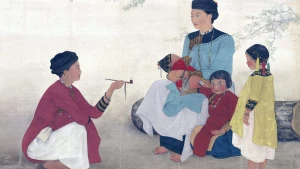
 This article explores Chen Chin's masterpiece, "The Women of Shantimen Area," through the perspective of curator Toshiko Rawanchaikun, examining its context and complex interpretations.
Summary
This article examines Chen Chin's (Chen Jin, 1907-1998) representative work, "The Women of Shantimen Area" (1936, Fukuoka Asian Art Museum), through an interview with Toshiko Rawanchaikun, a curator at the Fukuoka Art Museum. Chen Chin was a rare female Taiwanese painter educated in Japanese painting in Tokyo during the Japanese colonial period who achieved success in the Imperial Art Exhibition (Teiten). Rawanchaikun suggests that Chen Chin's work reflects the conflict of a "double minority": an elite position within Japanese society in the colony, and her perspective on the indigenous people. Specifically, "The Women of Shantimen Area," depicting the Paiwan indigenous community of Shantimen, responds to the Japanese examiners' expectations for "local color" while blending idealized femininity with wilder expressions. This duality mirrors the contradictions in Japanese colonial policy—forcing modernization while demanding the preservation of primitiveness. Rawanchaikun posits that Chen Chin may have depicted the indigenous women as a representation of "Other Taiwan" while simultaneously overlaying her own position as a woman onto them as a representation of "Self Taiwan," emphasizing the necessity of understanding this work's complex identity issues and historical background.
(Source:artscape)