AOYAMA Shin | "Alternative Computations — The Computational Culture of Festival" (Part 2)
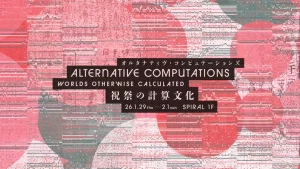
 This second part analyzes the exhibition "Alternative Computations" by intersecting mythology, biology, mathematics, and concepts of play.
Summary
This second part of the analysis explores the exhibition "Alternative Computations" by focusing on the motif of the frog (Taniguku) from Japanese mythology, connecting it to beings crawling on the earth, the developing fetus (Hiruko), and its role as a model organism in cybernetics research. Jun Tanaka links Hiruko to the developing fetus, suggesting that its hidden face harbors countless potential forms. The text contrasts the frog's retinal processing capabilities with the exhibition's camera system, interpreting the act of seeing/being seen as an inherent computational act. The analysis then shifts to the "embodied computational culture" exemplified by mathematician Kiyoshi Oka and poet Matsuo Bashō, exploring potential computation inherent in natural phenomena. Regarding play, the author introduces Miguel Sicart's concept of "joking play" (play that intentionally disrupts order) alongside Huizinga's and Caillois's frameworks, suggesting this disruption offers a meta-redundancy that balances technological rationality and play. Finally, while cautioning against the easy metaphorical link between quantum physics and art, the author concludes that if Aoki is sculpting the act of computation itself, it must exist ubiquitously as long as the world endures.
(Source:artscape)