[Professor Naoki Sato] "Art Appreciation Lessons Taught at Tokyo University of the Arts: A New Art History Seen Through East-West Comparison" Part 2: "Human Figures and the Four Seasons"
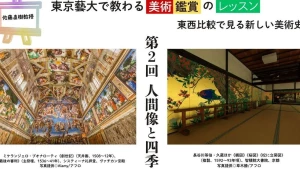
 Professor Naoki Sato compares Michelangelo's human-centric frescoes with Hasegawa Tōhaku's nature-focused screen paintings to illustrate fundamental differences in Western and Japanese aesthetics.
Summary
This article, the second installment of Professor Naoki Sato's series "Art Appreciation Lessons Taught at Tokyo University of the Arts: A New Art History Seen Through East-West Comparison," explores the contrast between human representation and the appreciation of the four seasons in Eastern and Western art. The comparison focuses on Michelangelo's frescoes in the Sistine Chapel, which overwhelmingly depict the human body as the pinnacle of Western artistic expression, versus the opulent gold-leaf screen paintings by Hasegawa Tōhaku and his school at Chishaku-in Temple in Kyoto, which feature trees and flowers symbolizing the four seasons. The architectural spaces themselves reflect this divide: the Sistine Chapel is a closed, stone-walled space focused inward on the human form, while the Chishaku-in hall integrates with the surrounding nature through its wooden structure and sliding screens, inviting the idealized seasons indoors. Professor Sato argues that these differences stem from fundamental cultural variations in what each tradition considers the standard of beauty—the human body in the West versus the contemplation of nature's cycles in Japan. Furthermore, compositional differences are noted, with Western art tending toward self-contained pictorial space, whereas Japanese screen paintings often present bold fragments of a larger landscape, encouraging the viewer's imagination to extend beyond the frame.
(Source:美術展ナビ)